Can we have an environmentally friendly death?
Some guidance for those who will be involved with arranging our funerals can be a great help so thinking ahead about an inevitable event is probably a good thing to do. Researching this subject was partly prompted by an intriguing opening line in a book read recently and it led me down an interesting path.
The line came from Mirabel Osler’s book The Rain Tree. It reads as follows;-
“I am on a search for a felt shroud.”
In time this prompted a visit last year to Dartmoor where these are made. They are quite beautiful and in time I hope to be buried in one. I dare not buy one yet as my house does a good line in moths! There was a time when burials in wool shrouds were enshrined in law. In 1666, and again in 1679, Parliament ordered that all bodies should be buried in a shroud of woollen cloth. Though chiefly intended to stimulate the English woollen industry, the measure remained on the statute book until it was repealed in 1814.
However one plans a funeral there will be compromises to make on environmental grounds and minimising one’s impact requires care. Short of being buried in one’s garden, and in England & Wales there is no law prohibiting burial on private land, and with mourners walking to see you off, perhaps with a few wildflowers for your grave, it is difficult not to affect the environment. Discouraging later visits to a grave if it involves using fossil fuels could be mentioned in a letter of wishes.
The following links may be useful:
- https://www.theguardian.com/sustainable-business/ten-eco-friendly-funeral-ideas
- https://www.goodfuneralguide.co.uk/wp-content/uploads/2021/01/iccm_Ken-2.pdf
- https://www.planetmark.com/wp-content/uploads/2023/08/Funeral-Report-Regulatory.pdf
- bbc.com/future/article/20230821-how-to-plan-a-sustainable-funeral
- https://www.bellacouche.com (makers of felt shrouds)
In brief, the carbon emissions associated with natural and traditional burials are minimal to very small, with Natural Gas Cremation the process with the highest emissions, due to the energy consumption required.
A simple biodegradable bag and manually dug grave is the most environmentally friendly way to choose, 0.3 kg CO2. At the other end of the scale is a cremation using a mahogany veneer coffin with chipboard sides and MDF base, with emissions of 37.3 kgs CO2. The difference in carbon emissions is enormous and unfortunately nearly 80% of funerals in the UK are cremations currently.
The emissions may not seem significant when considering one individual funeral, however when analysed collectively the impact is massive. Collectively, we can reduce more than 400 thousands tonnes of carbon emissions by choosing consciously. That’s equivalent to the emissions generated by an average family car driving around the earth’s equator more than 59,000 times.
Burial in Church Graveyard
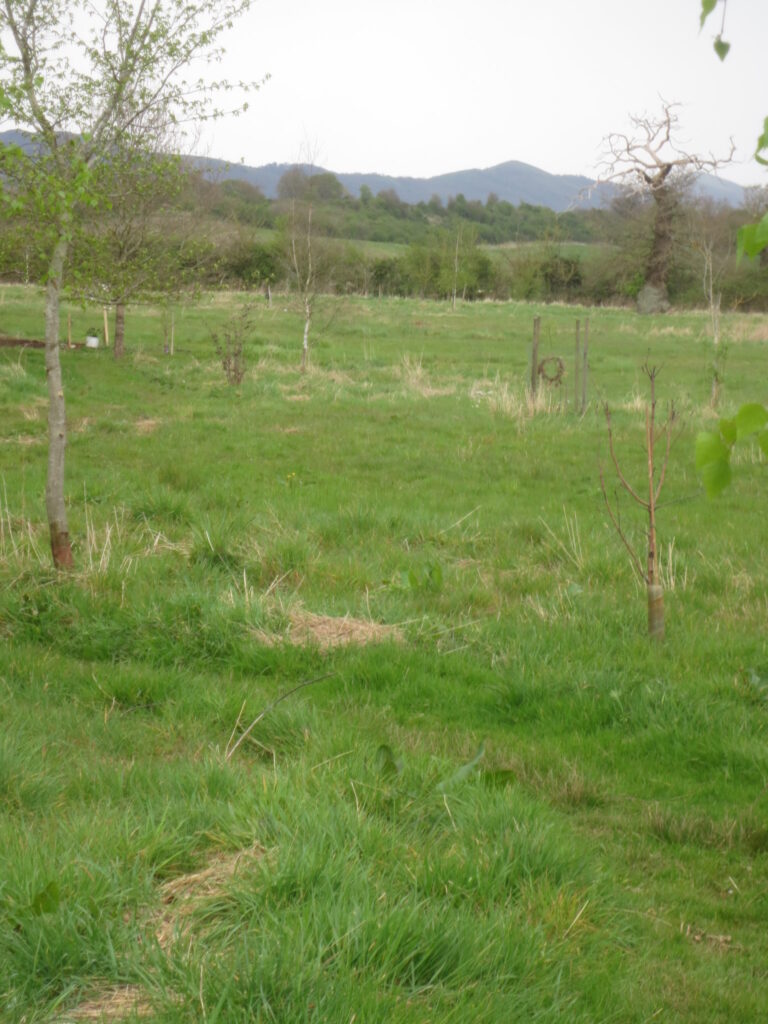
If you are a parishioner or inhabitant of a parish or die within the parish you have the right to be buried in the parish churchyard or burial ground. The churchyard at St. Gregory’s in Castlemorton has recently been enhanced by a large area of native wildflowers.
It is possible to be buried in a church graveyard without the burial service of the Church of England being performed if the person arranging the funeral gives notice to the rector, vicar, incumbent or officiating minister that a burial service of the Church of England is not required.
Natural Burial Grounds
www.funeralguide.co.uk/natural-burial-grounds
The closest natural burial grounds to Castlemorton are:
- Alne Wood Park
- Greenfields Woodland of Remembrance, Staunton
- Westall Park
Each offer quite a different setting and until one visits them it is difficult to judge their attributes.
Alne Wood Park Natural Burial Ground “is a peaceful 12-acre wildflower meadow, with far-reaching views of the beautiful Warwickshire and Worcestershire countryside. The site offers a less formal, nature-friendly alternative to a traditional cemetery for full-burial and also the interment of cremated ashes.”
Alne Wood Park uses discreet wooden markers and plots are located by what3words references.
Greenfields Woodland of Remembrance
“This site is a woodland pasture, an ancient habitat in which copses and groups of native trees such as oak, lime and hornbeam, are separated by areas of wildflower meadows”.
In theory, Greenfields limits what can be left on graves but in practice there is plenty there, which, to my eyes, spoils the place.
Westall Park “is one of the UK’s finest natural burial grounds and aims to create an eco-friendly woodland burial site as a place for quiet reflection, in an informal setting amongst trees, wild flowers and wildlife. Eventually it will become a woodland glade, full of nature where all wildlife is encouraged to thrive.”
Westall was one of the early pioneers of natural burials and now has rows and rows of remembrance plaques and so seems very commercialised to me, much more akin to a cemetery.
They all charge different amounts as well, which may influence people’s decisions.
Alternatives to burial or cremation
At present, human composting and terramation are not legal in the UK.
Similarly the case with alkaline hydrolysis, also known as water cremation, an alternative form of cremation that does not involve flames. It is available as a funeral choice in Canada and some parts of the U.S., but it is not yet available in the U.K.
Liz Ince